

New York State E.O. 62 - Establishing a Temporary Moratorium on Data Centers
An ISOC LIVE Summary
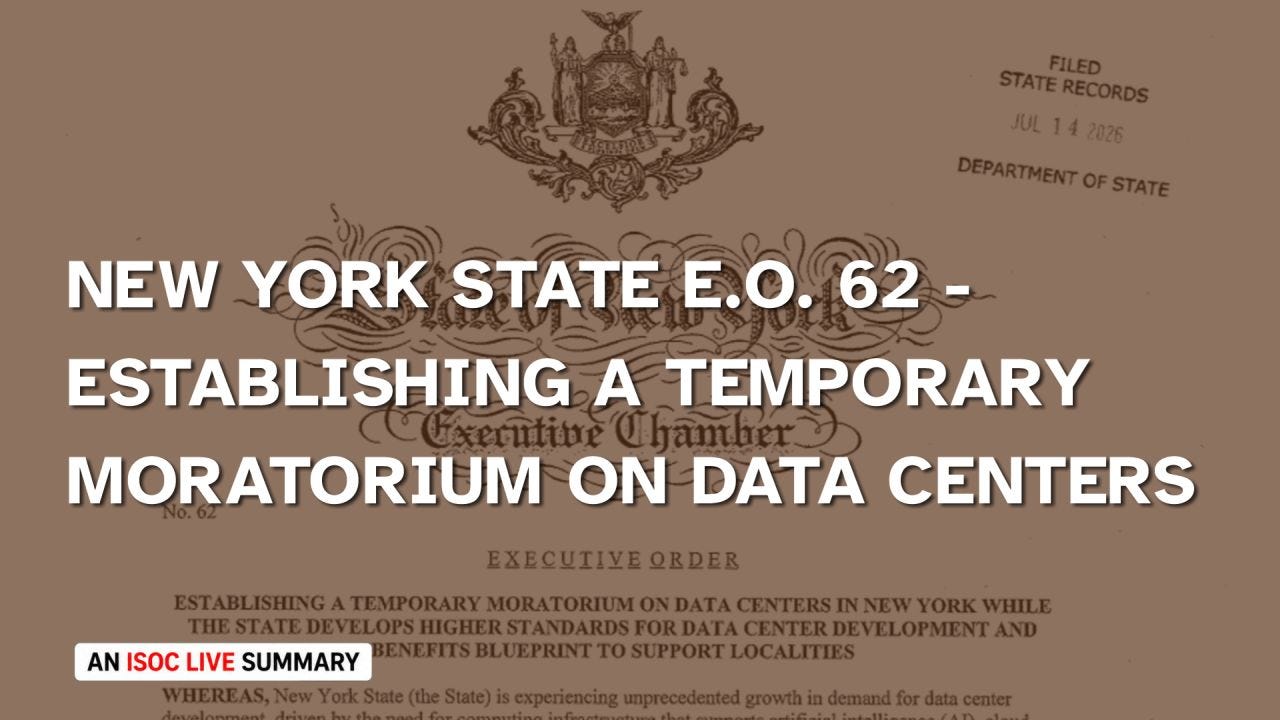
Executive Order No. 62 – Establishing a Temporary Moratorium on Data Centers in New York While the State Develops Higher Standards for Data Center Development and a Benefits Blueprint to Support Localities - issued by New York Governor Kathy Hochul at Albany and filed with the New York State Department of State -14 July 2026
Overview
Governor Kathy Hochul issued Executive Order No. 62, pausing New York State discretionary environmental permitting for large data centers while the State builds a regulatory framework for the buildout of AI and cloud computing infrastructure. The order cites unprecedented growth in demand for data center development, driven by computing infrastructure supporting artificial intelligence, cloud computing, streaming, and other computing operations, and raises concerns over electricity consumption, water use and treatment, local environmental impacts, grid reliability, stranded-asset risk, and the fair allocation of infrastructure costs.
The order notes that as of May 2026, nearly 12 gigawatts (12,000 megawatts) of data center load requests sit in the New York Independent System Operator interconnection queue, with more than eight gigawatts entering the queue in 2025 alone.
The order builds on Energize NY Development, announced in the 2026 State of the State, which directs the Public Service Commission to modernize how large energy consumers — including data centers — connect to the grid while ensuring those consumers pay their fair share or supply their own power. It is the policy of the State that the cost of electric system upgrades required to serve large loads should not be paid for by every-day New Yorkers.
Rationale
The order argues that existing State regulatory frameworks are not yet prepared to address:
Large-scale water use and treatment that could strain aquifers, surface waters, and public infrastructure.
Growth in statewide electric load that challenges the State’s clean energy targets and requires procurement of additional supply.
Unpredictable development that creates risk for utilities and ratepayers when infrastructure investments are made in anticipation of loads that may not fully materialize.
Siting and operation impacts on energy use, water quality, air quality, noise, lighting, and quality of life, which New Yorkers have raised as legitimate concerns.
Increasing competition for clean freshwater amid water-quality threats and climate-driven changes in precipitation and drought, making water reuse and best available conservation technologies increasingly important in high-water-demand sectors.
It also notes that while negotiating local benefits with developers is the responsibility of the locality, the State can offer technical resources and best practices to support those negotiations.
1. Data Center Permitting Moratorium and Generic Environmental Impact Statement (GEIS)
The Department of Public Service (DPS) is directed to examine the impacts of data center interconnection to the electric distribution network through its proceeding under Case 26-E-0045, Proceeding on Motion of the Commission to Address Interconnection Reforms for Large Loads. In connection with that proceeding, DPS is further directed to initiate a formal public process — including public comment and a public hearing — to create a Generic Environmental Impact Statement under the State Environmental Quality Review Act (Article 8 of the Environmental Conservation Law and its regulations), assessing the potential environmental impacts of data center construction and operation in the State, including energy demand, water use and quality, air quality, disproportionate impacts on disadvantaged communities, and noise levels. DPS is to submit a report of the Final GEIS and findings statement, consulting with the Department of Environmental Conservation (DEC) and other relevant agencies.
Until DPS submits that report:
DEC is directed to hold in abeyance all applications for any discretionary permit, approval, license, or similar permission for the construction or expansion of a data center that are or may be pending before DEC and that DEC has not determined to be complete before the date of the order.
As a condition precedent to a determination of completeness, DEC may require the applicant to identify and describe in writing whether the application relates to or involves the construction or operation of a data center.
The provision does not apply to permits, approvals, licenses, or similar permissions from local governments.
DEC is to assist DPS in preparing the GEIS.
2. Developing a Community Investment Framework
Empire State Development (ESD) is directed, within 60 days, to consider feedback on and create and post on its website a Community Investment Framework, to assist localities in analyzing and attaining local economic benefits and mitigating potential negative effects of hosting a data center.
The Framework is to include guidance associated with:
Creation and maintenance of a community investment fund into which developers or operators provide capital usable for energy affordability efforts and enhancements to public services such as child care, K-12 programming, or public infrastructure.
Investments in local infrastructure such as local energy distribution systems, broadband or irrigation systems, or wastewater treatment plants.
Frameworks giving organized labor a seat at the table, prioritizing prevailing wage standards and project labor agreements for construction, local hiring, apprenticeships, and workforce development.
Transparency through reporting requirements or other means, so communities understand key economic metrics associated with data center development.
Localities and other governmental entities — including but not limited to Industrial Development Agencies — may use the Framework to negotiate terms and conditions with developers or operators.
3. The New York Grid Acceleration Fund
DPS is directed to consider the development of a mechanism to protect all customers from the risk of significant costs and stranded-asset risks, including consideration of a New York Grid Acceleration Fund, and may consider such a mechanism as part of the Energize NY Proceeding.
The Fund may require data centers to:
Make upfront capital contributions to finance grid improvements.
Participate in demand response programs.
Support procurement of new clean energy supply, including distributed energy resources.
Contribute to an insurance pool to which developers may need to contribute.
DPS is to consider how contributions may be structured, including contribution levels and allocation, and to consider developing a process to work with utilities and stakeholders to identify necessary infrastructure improvements. A component may include measures protecting ratepayers from project delays, scope changes, or cancellations resulting in stranded assets. DPS may also evaluate approaches requiring data centers to fund new clean electric generation and/or dedicated battery storage, consistent with the State’s clean energy goals, including customer-sited distributed energy resources, to the greatest extent feasible. The Fund could also explore options to support energy affordability.
4. Interconnection, Reliability, and Cost Allocation
Within 60 days, DPS is directed to form a Data Center Interconnection Working Group to identify and resolve issues related to the interconnection of data centers and other large loads, supporting efficient interconnection of large new customers and faithful compliance with “beneficiary pays” principles as related to network upgrade and resource adequacy costs.
DPS is also directed to convene the State’s transmission owners to review their practices and methodologies for studying the system impacts of data centers and other large loads, in order to understand their sufficiency for estimating and managing cost impacts — both as they relate to network upgrades and to supply. DPS is directed to report to the Commission within 90 days.
Data centers may also be subject to service classifications and requirements developed by DPS and as may be established by the Public Service Commission.
5. Data Center Water Withdrawal Review and Report
DEC is to assess whether new or amended regulations, policies, reporting, or guidance is necessary or appropriate to help ensure its water withdrawal program requirements — pursuant to 6 NYCRR Parts 601 and 602 — accurately and completely reflect the water demands of large use customers in the State, including data centers.
No later than twelve months after the date of the order, DEC is to deliver a report setting forth the results of the assessment and identifying potential regulatory, policy, and guidance actions necessary or appropriate to address concerns associated with the siting and operation of data centers in the State.
6. Definition
For purposes of the order, a “data center” means a facility or group of facilities located on the same site or contiguous sites used to house computer servers, associated components, or computing or telecommunications equipment for the storage, processing, distribution, and/or management of data. Characteristics of covered data centers include servers, associated components, or computing or telecommunications equipment which:
Are in facilities containing uninterruptible power supply systems, specialized cooling systems designed for high-density computing loads, and/or contain cybersecurity systems designed for secure digital infrastructure operations;
Provide data storage, cloud computing, and/or content delivery to customers, internal operations, and/or affiliated business operations, oftentimes on a continuous twenty-four-hour cycle; and
Consume or can consume 50 megawatts of energy or more.
Not covered: facilities primarily used for manufacturing; research (including but not limited to quantum computing research or biomedical research); education (including but not limited to facilities used by accredited New York State colleges and universities to the extent they are engaging in academic research, and the Empire AI consortium, or the institute, as defined in section 361 of the Economic Development Law); or the provision of medical care.
7. Agency Consultation
In implementing the order, DEC, DPS, and ESD are to consult with one another and with additional partner agencies and authorities, including but not limited to:
Authorities Budget Office.
Department of Health.
New York State Energy Research and Development Authority.
Long Island Power Authority.
Department of State.
New York Independent System Operator.
Overall
Executive Order No. 62 pauses DEC discretionary permitting for large data centers while DPS runs a SEQRA Generic Environmental Impact Statement tied to its Large Loads interconnection proceeding, and directs parallel work on community benefits guidance, ratepayer protection against stranded assets, interconnection and cost allocation reform, and water withdrawal regulation. The order seeks to ensure that AI-driven computing infrastructure is developed in a way that protects electric ratepayers, water resources, environmental quality, and host communities while maintaining reliability and advancing the State’s clean energy objectives.
RESOURCES
Executive Order No. 62 — the full text, filed 14 July 2026
Case 26-E-0045 — the Large Loads interconnection proceeding the GEIS attaches to
2026 State of the State — where Energize NY Development was announced
Department of Public Service — leads the GEIS, the Grid Acceleration Fund review, and the interconnection working group
Department of Environmental Conservation — holds discretionary permits in abeyance and runs the water withdrawal review
Empire State Development — must post the Community Investment Framework within 60 days
State Environmental Quality Review Act (SEQR) — the Article 8 framework governing the Generic Environmental Impact Statement
Water Withdrawal Permits and Reporting — the 6 NYCRR Parts 601 and 602 program under review
New York Independent System Operator — operator of the interconnection queue holding nearly 12 GW of data center load requests
Empire AI — the consortium excluded from the order’s data center definition